Real-Time Cell Adhesion Analysis
Adhesion is a dynamic process, but fixation and staining only ever show a snapshot. xCELLigence RTCA follows adhesion and spreading kinetics continuously, in one step and label-free.
Cell Adhesion: Why It Matters
Cell adhesion is a fundamental biological process in which cells attach to each other or to the extracellular matrix (ECM) through adhesion molecules. It is essential for tissue structure, signal transduction, and proper cellular responses to the surrounding environment.
Healthy cell adhesion underlies key physiological processes such as wound healing, platelet coagulation, immune responses, and embryonic development. When adhesion is disrupted, it can contribute to disease, for example, reduced adhesion enables cancer cells to detach and metastasize, while excessive adhesion can promote inflammatory or cardiovascular disorders through the accumulation of platelets or leukocytes.
How Cell Adhesion Is Traditionally Measured
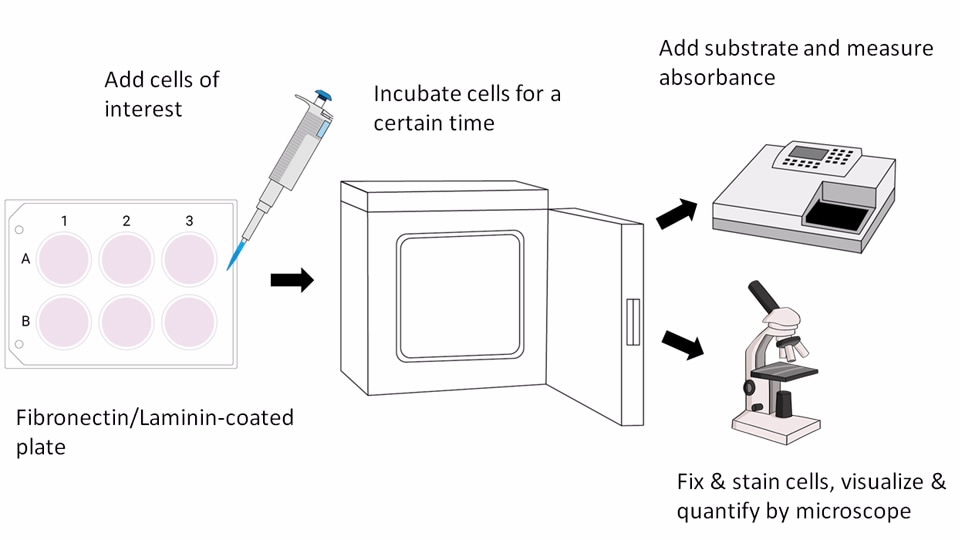
Common methods include:
- Attachment assays: Colorimetric detection of cells bound to an adhesive substrate.
- Spreading assays: Microscopic evaluation of cell flattening and morphology to assess adhesion strength or inhibitor effects.
While widely used, these approaches rely on fixation, staining, and endpoint measurements—providing only a limited snapshot of a highly dynamic process.
Real-Time Monitoring of Cell Adhesion
xCELLigence RTCA technology provides a simple, one-step, label-free method to continuously monitor cell adhesion and spreading kinetics.
Real-time, highly sensitive quantification of cell adhesion and spreading.
Label-free workflow—no fixation, staining, or sample processing required.
Physiologically relevant conditions—cells remain alive and unperturbed throughout the experiment.
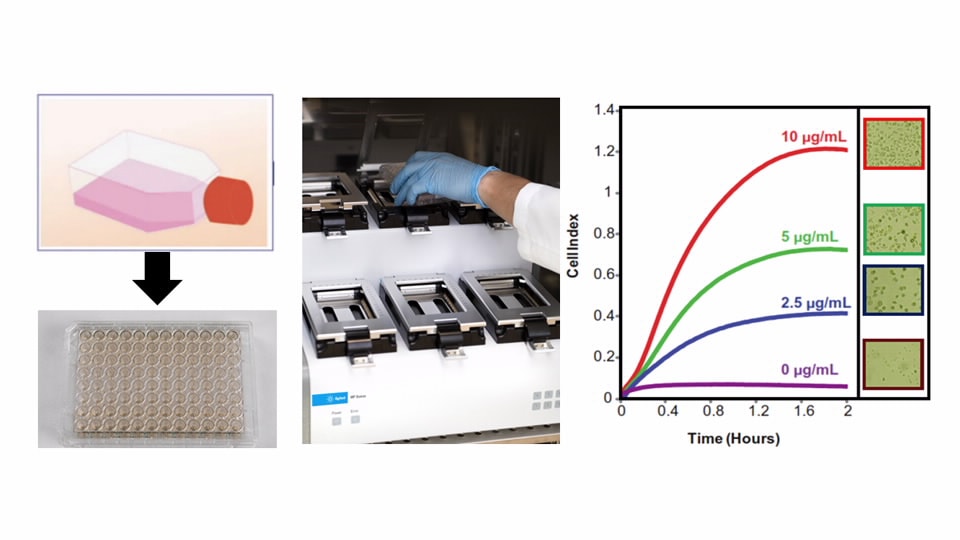
Step 1: Seed cells and place the E-Plate in the incubator. Configure the measurement schedule in the xCELLigence software.
Step 2: Perform media changes or add treatments as needed.
Step 3: The system automatically collects kinetic adhesion data in real time.
Example data: Comparison of ECM proteins
Top graph: Dynamic monitoring of cell attachment and spreading on Poly-L-Lysin (PLL)- and Fibronectin (FN)-coated surfaces. The Cell Index correlates with the extent of cell attachment and spreading.
Lower images: Cell Index values correlate with conventional phalloidin-based staining of the actin cytoskeleton, validating the real-time impedance measurements.
Application Note: Dynamic Monitoring of Cell Adhesion and Spreading

Literature
Application Notes
Dynamic Monitoring of Cell Adhesion and Spreading
Publications
- Platelet impedance adhesiometry: A novel technique for the measurement of platelet adhesion and spreading.Polgár L, Soós P, Lajkó E, Láng O, Merkely B, Kőhidai L. Int J Lab Hematol. 2018 Jun;40(3):372-381. (Semmelweis University, Hungary)
- Kynurenic acid and its derivatives are able to modulate the adhesion and locomotion of brain endothelial cells.Lajkó E, Tuka B, Fülöp F, Krizbai I, Toldi J, Magyar K, Vécsei L, Kőhidai L. J Neural Transm (Vienna). 2018 Jun;125(6):899-912. (Semmelweis University, Hungary)
- Using xCELLigence RTCA Instrument to Measure Cell Adhesion.Hamidi H, Lilja J, Ivaska J. Bio Protoc. 2017 Dec 20;7(24). pii: e2646. (University of Turku, Finland)
- Impedimetric Analysis of the Effect of Decellularized Porcine Heart Scaffold on Human Fibrosarcoma, Endothelial, and Cardiomyocyte Cell Lines.Henrik Bäcker, Livia Polgár, Pal Soós, Eszter Lajkó, Orsolya Láng, Bela Merkely, Gabor Szabó, Pascal M. Dohmen, Alexander Weymann, Laszlo Kőhidai. Med Sci Monit. 2017; 23: 2232–2240. (Heidelberg University, Germany)
- α-MSH modulates cell adhesion and inflammatory responses of synovial fibroblasts from osteoarthritis patients.Böhm M, Apel M, Lowin T, Lorenz J, Jenei-Lanzl Z, Capellino S, Dosoki H, Luger TA, Straub RH, Grässel S. Biochem Pharmacol. 2016 Sep 15;116:89-99.
- Structural and functional analysis of cell adhesion and nuclear envelope nano-topography in cell death.Kwon HK, Lee JH, Shin HJ, Kim JH, Choi S. Sci Rep. 2015 Oct 22;5:15623. (Ajou University, Korea)
- Using cell-substrate impedance and live cell imaging to measure real-time changes in cellular adhesion and de-adhesion induced by matrix modification.Rees, M. D., Thomas, S. R. Vis. Exp. (96), e52423, doi:10.3791/52423 (2015).
- Curcumin targets breast cancer stem-like cells with microtentacles that persist in mammospheres and promote reattachment.Charpentier MS, Whipple RA, Vitolo MI, Boggs AE, Slovic J, Thompson KN, Bhandary L, Martin SS. Cancer Res. 2014 Feb 15;74(4):1250-60.
- New blocking antibodies impede adhesion, migration and survival of ovarian cancer cells, highlighting MFGE8 as a potential therapeutic target of human ovarian carcinoma.Tibaldi L, Leyman S, Nicolas A, Notebaert S, Dewulf M, Ngo TH, Zuany-Amorim C, Amzallag N, Bernard-Pierrot I, Sastre-Garau X, Thery C. PLoS One. 2013 Aug 16;8(8):e72708.
- A role for adhesion and degranulation-promoting adapter protein in collagen-induced platelet activation mediated via integrin a2b1.Jarvis GE, Bihan D, Hamaia S, Pugh N, Ghevaert CJ, Pearce AC, Hughes CE, Watson SP, Ware J, Rudd CE, Farndale RW. J Thromb Haemost. 2012 Feb;10(2):268-77.
- Dynamic monitoring of cell adhesion and spreading on microelectronic sensor arrays.Josephine M. Atienza, Jenny Zhu, Xiaobo Wang, Xiao Xu and Yama Abassi. J Biomol Screen. 2005 Dec;10(8):795-805.
For Research Use Only. Not for use in diagnostic procedures.